Everything You Need to Know About Staying Comfortable All Year Long

At Blue Ridge Heating & Air, we know comfort in the Carolinas isn’t just about cooling off in the summer, it’s about staying cozy in the winter, keeping humidity in check, and saving money every month of the year. We’re going back to one of our recent seminars where Brian and Derek talked about modern HVAC technology and how today’s systems can transform home comfort.
Here are some of the highlights including real questions from participants and answers from our experts.
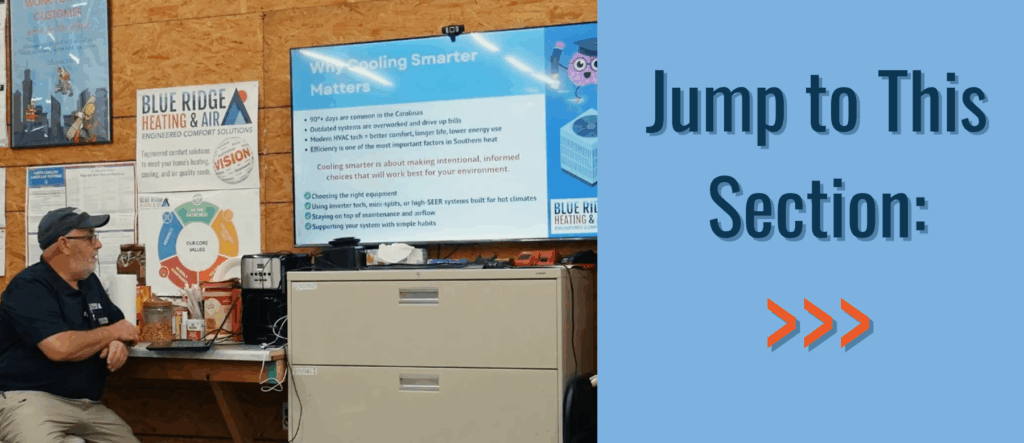
Why Smarter Systems Matter Year-Round
Brian, one of our team members, opened with a quote:
“The bitterness of poor quality remains long after the sweetness of low price is forgotten.”– Benjamin Franklin
That couldn’t be truer when it comes to HVAC. Cheap, outdated systems may seem fine upfront, but they often struggle with Carolina summers and winters, driving up power bills and wearing out too soon. Modern HVAC systems, by contrast, offer:
- Consistent comfort in hot and cold seasons
- Energy savings up to 30% compared to older units
- Longer system life with less strain
- Potential federal tax credits and local rebates
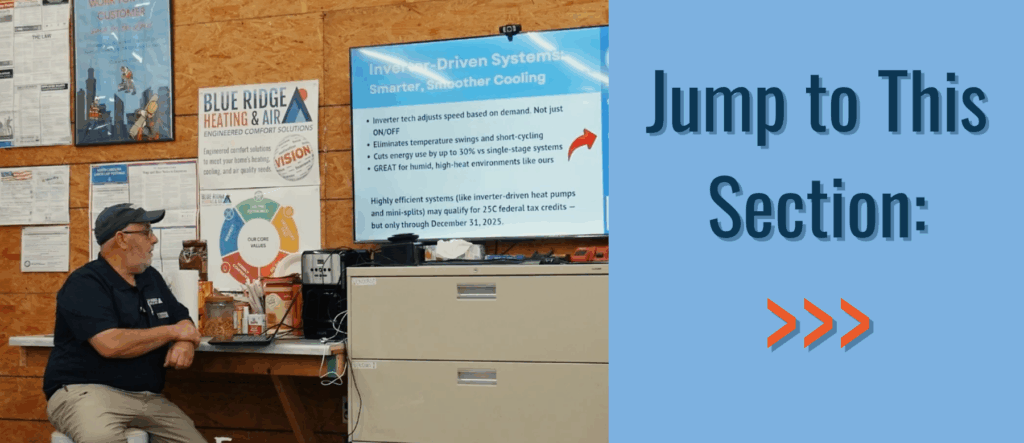
Inverter Technology: Smarter Heating and Cooling
Instead of simply turning on and off, inverter-driven systems modulate their speed to match demand. That means:
- No more hot/cold swings in your home
- Smoother, quieter performance
- Lower energy use year-round
- Extended system lifespan
These systems can also qualify for up to $2,000 in federal tax credits, making them a smart financial choice too.
Mini Splits: Precision Comfort
Our team explained that ductless mini splits provide room-by-room control with benefits like:
- Whisper-quiet operation
- No energy loss through ductwork
- SEER ratings often above 20+
- Up to 40% energy savings
- Rebates of $200–$600 from many utilities in NC and SC
Customer Q&A: Mini Splits and Zoning
Homeowner question: “Are more people switching to mini splits for specific areas, like a garage apartment or an addition, instead of upgrading their whole system?”
Brian’s answer: Absolutely. Mini splits are fantastic for targeted comfort — whether in a garage, sunroom, basement, or new addition. They let you heat or cool one section of the house without affecting the rest.
Homeowner follow-up: “So you can just install one in an addition without touching the main system?”
Brian: Exactly. Mini splits are flexible and often don’t require duct modifications, which makes them cost-effective for zoning needs.
When asked about manufacturers, Brian shared:
“Our primary brand is Mitsubishi. They’ve been around for years and have the fewest warranty issues in the market.”
This reassures homeowners that they’re investing in proven, reliable systems.
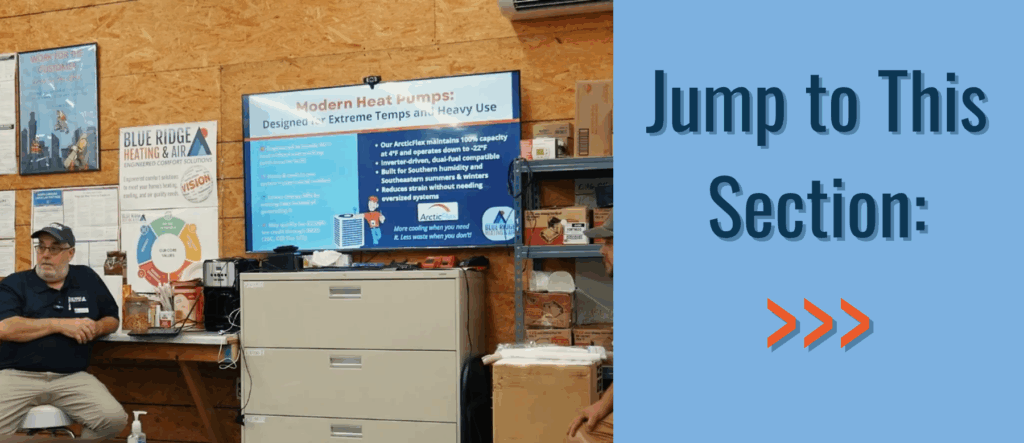
Whole-Home Comfort: Arctic Flex
While mini splits shine in individual spaces, some homeowners asked about whole-home solutions. That’s where the Arctic Flex and Arctic Flex Plus come in.
Homeowner question: “So is the Arctic Flex a whole-house system that works with existing ductwork?”
Brian’s answer: Yes. Arctic Flex is designed for the entire home, delivering up to 18 SEER efficiency, working with ducted applications, and maintaining capacity even in extreme conditions.
Derek added:
“I’ve seen Arctic Flex units blow 165°F air in the winter without even using the backup heat strips. The heating side of these systems is unbelievable.”

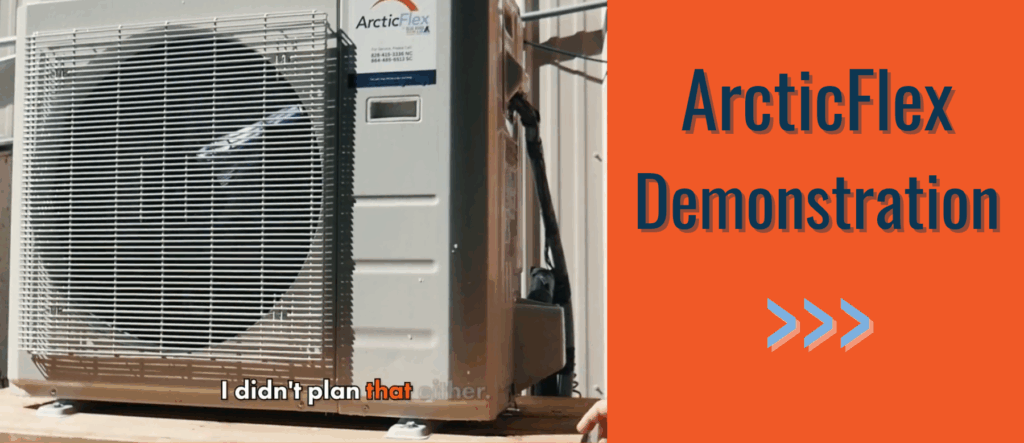
Experience the ArcticFlex Difference
Cutting-edge systems like ArcticFlex deliver comfort, efficiency, and peace of mind. If you’d like to learn more about upgrading your home’s heating and cooling, give us a call today or visit one of our upcoming seminars.
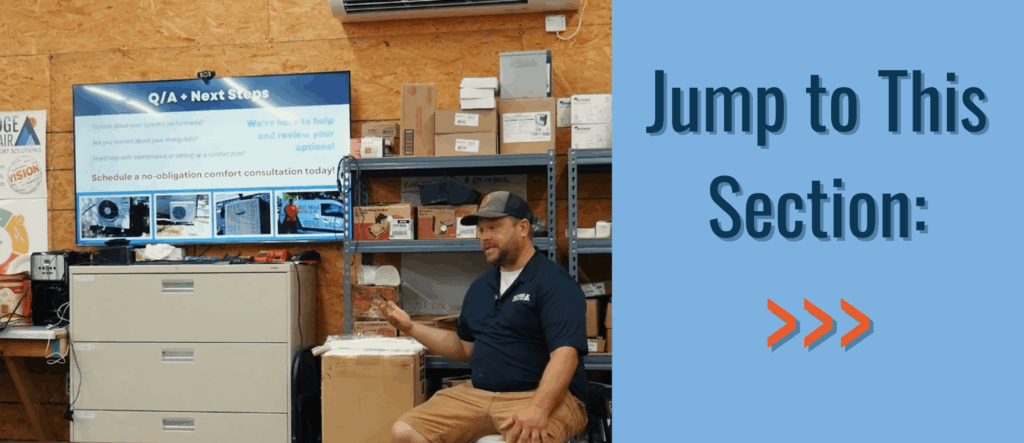
Maintenance: Protecting Comfort Year-Round
Derek also explained why preventative maintenance is so important.
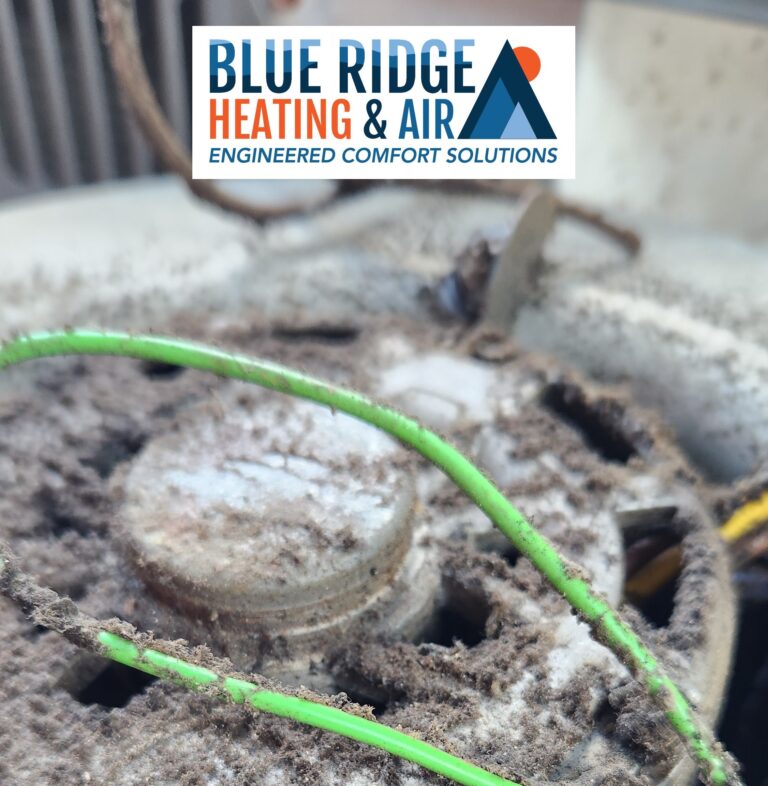
“When we come out twice a year, we clean the coils, check all electrical components, tighten connections, and make sure nothing’s been damaged by rodents or debris. That way, you don’t have to worry about a surprise breakdown.”
Maintenance plans include:
- Two seasonal checkups (before summer and winter)
- Priority scheduling during peak seasons
- Discounts on repairs
- Peace of mind that your system is running at its best

Upgrade Before Incentives Expire
Between federal tax credits (up to $2,000) and local utility rebates, now is the best time to upgrade. Don’t wait until older systems fail, or until rebates run out in 2026.
The Future of HVAC: Smart, Clean, Efficient
The seminar wrapped up with a look at where HVAC is headed:
- Smarter refrigerants like R-454B with lower environmental impact
- Wi-Fi enabled systems that adapt to real-time conditions
- Hyperheat technology for extreme temperatures
- Improved humidity control for year-round comfort
Heating and Cooling Issues? Click Here!
📞 Ready to feel the difference in your own home?
Schedule a free comfort consultation with us today. No pressure, no pushy sales tactics. Just good folks helping you stay informed and save money.
✅ Get a quote
✅ Get it done right
✅ Sleep better
Modern Cooling Technology Seminar: Transcript
Brian: ‘What southern homeowners should know this heat wave?’ And this is a quote from Ben Franklin. “The bitterness of poor quality remains long after the sweetness of the low price is forgotten.” I thought that was pretty interesting. “Why cooling smarter matters. 90 plus days are common in the Carolinas. Outdated systems are overworked and drive up power bills. Modern HVAC techs equal better comfort, longer life, lower energy use, efficiency is one of the most important factors in the southern heat. Cooling smarter is about making intentional, informed choices that work best for your environment. Choosing the right equipment, using inverter tech, mini splits or high seer systems built for the hot climates. Staying on top of maintenance and airflow, supporting your system with simple habits.
Inverter driven systems: smarter, smoother cooling. Inverter techs adjust speed based on demand, not just on/off. Eliminates temperature swings and short cycling. Cuts energy use by up to 30% versus single stage systems. Great for humid, high-heat environments like ours, highly efficient systems like inverter driven pumps and mini splits may qualify for the 25C federal tax credit, but only through the end of this year. So after this year, they’re gone away. Considering an upgrade? $2,000 make max credit for eligible heat pumps, must meet CEE tier one performance standard. Don’t wait until the pricing is available and availability shifts in 2026.” So you know about the ductless and these different things we have.
Guest 1: Are a lot of people going over to that over the individual unit for an entire floor or I mean to zone the system off?
Brian: Yes, especially in garages, basically over the garage apartments. They’re great for that and even if you just want one section that you want to have it hotter or cooler, or even in the basement for a lot of applications.
1: Or if you put an addition on or something, you don’t have to upgrade the whole system. You can just put one of those guys in.
Brian: Yes, sir.
1: Yeah.
Brian: So you can do that with one or two heads or you can do a seal and get set. There’s many applications you can use with that.
1: And you guys install and maintain those?
Brian: Yes, sir.
1: What make of manufacturer?
Brian: We have Mitsubishi, which we install quite a bit of it. That’s our primary one. Then there’s Dakin. Then there’s Gris. There’s the three we we’re working with. There’s after-
1: Mitsubishi was the first one to come out with it, wasn’t it?
Brian: I don’t know if it was the first one, but they’ve been around for a lot of years and they’re very good. They have the least amount of warranty issues on the market. Have questions. We got people like Derek, James and Corey. You work with them quite a bit.
“Mini-Splits, precision comfort where you need it.” As you said, like in just different sections of the house, they work great. “Are mini-split’s right for the southern heat? Built for extreme heats, most modern cooling efficiency in 100 plus temperatures where inverter driven performance. Tax credit eligible qualifies for $2,000 federal credit. Must meet the criteria. Utility rebates available, many North Carolina and South Carolina. Utilities offer $200 to $600 rebates per system. I wish it was 2,000. Ductless, no duct loss, better performance. Room by room cooling without duct loss. Idea for bonus rooms, upstairs, sun rooms, garages. We’re talking about duct loss. If you don’t have that duct work that you have to worry about, that’s what we’re talking about, duct loss. Sierra rating often exceeds 20 plus. Whisper Quiet, energy efficient, low power bills, no duct loss again, and zone controlled. Up to 30 to 40% energy saving.” They’re real sweet.
“Modern heat pumps designed for extreme temperatures and heavy use, engineered to handle 90 plus temperatures without overworking with inverter tech. Heat and cools in one system. year-round comfort. Lower energy bills by moving heat instead of generating it. May qualify for the $2,000 tax credit.” Our ArcticFlex, this is the system we installed here at the shop. We’ve talked about that a little bit over time. “Maintains up to 100% capacity at four degrees Fahrenheit and operates down to minus 22 degrees. Inverter driven, dual fuel compatibility, built for southern humidity and southern summers and winters. Reduces strain without needing oversized systems.
What changed in the HVAC lately? The future of HVAC is smarter, cleaner, and more efficient. More local utilities, rebates, example Duke, and tax credits end at the end of this year.” Duke offers a lot of credits for thermostats, the efficiency, and different things. And even if you do it early, you don’t want to wait until it goes down. You can change it out and it qualifies for even more credits. Excuse me, rebates. “Advanced inverter compressor, more precise modulation equals better humidity control and less energy use. Hyperheat and extended temps models. No unit maintains 100% capacity in both extreme heats, 100 degree plus and cools down to minus 22. Enhanced refrigeration R454B. lowers the environmental impact and improves performance in variable speed systems. Smart heat pumps and wifi enabled response to real time conditions integrates with smart thermostats for zoning and learning behaviors.”
Here’s where the maintenance comes in. “Small tasks, big improvements in cooling performance. Changing your filters monthly during the heavy use, rinse off your outdoor units, clean the coils, keep shrubs and grass at least two feet away from your condenser.” A lot of the people cutting grass, they want to blow it toward the unit. So you out there and hose it down. “Using seal fans to circulate colder air, which leads to number five, avoid setting thermostat drastically low. You’re aiming for 76 to 78 degrees.” Some people like it that way. Some people want it colder. Some people want it a little bit warmer.
1: Are these considered heat pumps?
Brian: Yes, sir. And this shop, that thing will heat this shop down. And when they come in here in the winter time. They’ll open that door, it’s 10 degrees outside and the guys forget to close it. It, know, 30 minutes, it’d be back to temperature. That’s how efficient that is.
“What’s worth upgrading in the time when the time comes, if the time comes? Worth it: Inverter units, mini splits, variable speed air handlers. Situational: duct replacement, zoning, indoor air quality uh enhancements. Maybe not yet: full system replacements, if yours is younger than 10 years and running efficient. start with what saves you money and solves your current comfort issues, what matters to you.
Comfort plans for preventative maintenance. Why does it matter? Even if your system is good shape now, routine care is the number one way to keep it that way and protect your investment. What’s included? You get two checks per year per system. One before summer, one before winter. Priority schedule. Skip the line during peak season. Repair discounts, save money if something ever goes wrong, system longevity, support, protects your investment and keeps your system running efficiently.” Derek, can you elaborate on what we do on our maintenance, so to help it run longer. And what do you see that helps?
Derek: We’ll go in, in the summertime, If you have a heat pump, if we go in, it’s easy access. We’ll spray it off, keep it clean, which means better airflow, less stress on the system, everything’s happy. We’ll check your fan speed, make sure your amps are good, capacitors, make sure there’s no burnt spots inside as far as electrical boards. Wires get loose over the years, vibration. We check and make sure they’re all tight, snug. We’ll go to your outdoor unit, check all your electrical components like, you know, capacitors, amps, contactors, make sure your coil is clean. Make sure there’s nothing that’s going to make you call us before it’s time to see you again. Right. And even in indoor, check your duct work, make sure there’s no duct leakage, you know, make sure there’s no rodents. You know, rodents can get in there and make sure everything is how it’s supposed to be. Um, and it just, it’s better for you guys cause it’s a good, you know that we’ve been there. We’ve, we’ve checked over your stuff. We’ve showed you from front to back. Basically what’s good? What’s bad? It’s up to you. You know, it’s always up to the customer to whether we, you know, we do something now or we wait. You’ve been very proactive. We’ve replaced a bunch of stuff on yours and You haven’t called me back in a while. it’s just, it’s a good, it’s a good safety net to know that you guys are, you don’t have to worry about, is it going to quit tomorrow? Is it going to quit next week? No, we’ve done been there. We’ve done checked over this thing from front to back. And once, when, when we leave, I know for a fact that you shouldn’t call us back until six months. So it’s just a good safety and it makes me feel better that you’re taking care of your stuff. I get to take care of it, it’s nice.
Brian: What have you found in the outdoor units?
Derek: Geez. Snakes, bees, chipmunks, squirrels, rats. I mean, you name it, birds. I mean, you name it, they’ve been in it.
Brian: So that’s what I was, I alluded to that because that’s peace of mind. You’re not going to go in there and look for it. You know, with those guys going out there twice a year to check it, it gives you peace of mind that it’s been expected. ‘Cause usually what happens is they’ve chewed through the wires. They’ve done something damage and now you’re down. You’re waiting for us to get there and then it’s going to cost more to get it repaired. So…
1: I go out and check my condensers down outside. I have three units every year, mean every year, a couple times probably every month and then I sweep around the outside of it, get all the leaves out of the way so you get a chance to breathe in there and keep it all clean, the base and everything.
Brian: And you’re inspecting, but you’re not opening it up where the critters.
1: No, no, no.
Brian: And with that, I’ll just add to this, “Curious about your system performance? Are you worried about your energy bills? Need help with maintenance? We’re setting up your comfort plan. We’re here to help.” So, and you know about us, we’ve been with you for how long? Thank you for joining us.
1: If you take a, let’s just say a 15, 1600 square foot house, three bedroom, two bath home, one level to replace with those mini splits in that house, as opposed to a full system two and a half ton unit, which is already installed. What’s the difference in cost? Approximately, I wouldn’t hold you to it.
Brian: I really don’t know because you’re looking at how many heads you’re going to put in there. um The hard part is you’re not going to put one in the bathroom. No, you see what I’m saying? So you get the air distribution through a house that’s already been set up for that would be very difficult to do and wouldn’t be cost effective. I don’t think um now-
1: There are systems already in that already use ductwork.
Brian: Yes, sir. Those won’t work. That’s correct. Now there are systems that run on the same technology. that you can use for ducted applications.
Derek: They do have the mini splits. That’s basically in.
1: What’s it called?
Derek: It’s an AMT. Is that correct? It’s basically the same thing, but it’s a Mitsubishi product. And that’s the Arctic Flex.
1: So that’s a whole house system?
Brian: Yes, sir. Yes, sir.
1: Okay. And then what’s that in comparison to just an everyday, what is it now 15, 16 SEER or how many SEER? Is there going to be a requirement soon or is now?
Brian: 14.5 or 15.2 is where they’re going.
1: Yeah.
Brian: But at the same time, these can go up to 18 to 20 SEER. And so there now you have the Arctic Flex Plus and the Arctic Flex. The Arctic Flex Plus is the one that’s really, really the driver where it’s real low in temperature or really high in temperature that really it goes into overdrive.
1: How do you spell it?
Brian: Arctic Flex. A R C T I C.
1: A R C.
Brian: Yes, I had to look at the board real quick. So, um.
1: Oh, Arctic Flex, I got it.
Brian: And if you go with the Arctic Flex Plus, it goes down to minus four degrees at 100%. What it does, it runs at 60 hertz normally, or it may drop down to 40 hertz if I’m not having to do work very hard. But if it’s 90 degrees, it can go up to 110 hertz and to overdrive to get it to temperature. And the winter time, it can go up to 120 hertz in the heating mode to help reheat the house and bring it up to temperature. So with that technology..
1: And that’s considered a heat pump?
Brian: Yes sir.
1: And a very efficient high SEER heat pump.
Brian: I think it’s an 18 SEER. And it’s a side discharge outdoor unit. I don’t know if you’ve walked back there and saw it yet.
1: Where is it?
Brian: It’s right behind the building. We can take it. We’re glad to show you what we’re talking about.
1: And that can work with existing ductwork?
Brian: Yes, sir.
1: You put in many of those?
Brian: Quite a few.
1: And what’s that? Again, cost of that in relation to a regular, like I said, SEER or whatever.
Brian: Probably about three or four thousand dollars. I think I’m not a hundred-
1: Approximately higher. But you get the efficiency out of it.
Derek: Yes. And you get the tax credit. So by the time you get the tax credit-
1: By the end of this year.
Derek: Yes. By the time you get the tax credit, I mean, for an extra 700/800 bucks to get the efficiency. And the good thing about these is think about in the winter time, this is a standard heat pump system. You got a 60, a 10 KW heat strip, which is 60 watt, know, 60 K or 10 KW.
1: Emergency heating.
Derek: You’re right. Auxiliary. This thing, so basically if it’s 35 degrees outside, your auxiliary heat’s gonna run, and with this, it’ll probably never run. Honestly, you’ll never see your heat strips kick on. We’ll install them.
1: Well, this has heat strips too?
Derek: Yes, yes. Just for a back, think about it for a backup purpose. Say something happens to this thing, three or four years down the road, it takes four or five days to get your part. We can turn them, heat strips on, you can have some kind of heat. So it’s just a, it’s a good safety. And if it does get below, you know, four degrees outside, if it does need it, it’s, it’s nice to actually have something if, if it does. In the field, I’ve seen these things out of the vents, no heat strips. It’s 60 degrees in the house. It’s blowing 165 degree air out of the vents and without heat strips. So that’s almost a hundred degrees. I mean, it’s the heating side of these things are unbelievable. They’re, they’re just, it’s amazing.
1: And what’s the size of that in relation? Not very much, not that much different.
Derek: No, they’re very similar.
1: Can do the, it can be vertical or horizontal as well as vertical? Install?
Brian: Yes, sir. Horizontal left, horizontal right, downflow, upflow. Multi-position.
Derek: And then in the fact that’s just not using the heat strips in the winter time, that’s going to save you a chunk of money.
1: Especially with the cost of electricity continuing to go up.
Brian: With that, when it goes into defrost, it shuts the blower off inside. So this way you’re not having to bring the heat strips on in the defrost mode. So when it defrosts, it shuts down the indoor blower, defrost outside, spring comes back on, but the blower doesn’t start running until the coil meets, I think it’s 82 degrees. So you’re not getting that cold coil blast of cold air into the house. We had problems starting this up because we had the door off and the shop was very cold. And we put the door on and the blower started to run, but it would not come on.
1: You mean the door of the unit?
Brian: Yes, sir. So again, I thought that was neat technology in that application.
1: What percentage of those Arctic Flex units do you install as opposed to a regular full house 15 SEER you know, regular unit heat pump?
Brian: I’d say 60, 40 maybe, would you?
1: Oh really? That much, huh?
Derek: Yeah. Cause I mean the best kicker is the NOG. The emergency heat in the winter time. And what your power bill is in the summer is what it’s going to be in the winter. So it’s not going to vary, you you’re not going to see that a hundred dollar, a hundred, you know, difference in this, you know, in between the seasons. So, and that’s a really good, people really like that.
Brian: They tend to run longer, maintain, but at a lower speed so that you don’t have those temperature spikes and drops. So that makes it real nice as well.
Derek: And the inverter driven. If it needs it, it’s there. If it doesn’t, it ramps down and keeps you satisfied.
1: And you draw more power when you start up any one, don’t you? As opposed to run. Is the startup power surge a little bit more than if it runs constantly?
Brian: That’s where… With anything, yeah. Most of your strain on the equipment is to start up and stop. So the hard stops, the hard starts. And there’s ways around it, but at the most, these systems start off very slow and ramp up. Anything else, sir?
1: No, this was kind of what I was interested in asking about. Those units are good. I mean, I didn’t know that much about them, but I got a lot more information. And he’s saying you’ve got YouTube videos on all of this, this is all gonna be put on? Yeah.
Derek: Well, it’ll heat down to negative 22 degrees at, what is it? Is it?
Brian: I don’t know the percentage.
Derek: I forgot what the percentage is, I need to put that. But I mean, if it ever gets down to negative 22 degrees, we’re coming to your house to stay in your heat.
1: All right, thanks guys.
Brian: You wanna take a walk out back and look at that?
1: Yeah, yeah. Let me take a look at that.
—————————————————–
Brian: So this is a side discharge. Reused old line set was in there. Electricals right there.
1: How much different is this than the condenser for the mini splits?
Brian: They’re very similar. There’s one. There’s one on the wall. That’s a three ton unit. This is a two ton unit. You hear it starting?
Derek: Quiet.
1: Yeah.
Derek: Whisper quiet.
Brian: And I didn’t plan that either.
1: How big is that one?
Brian: That’s a three ton unit.
1: And each mini split unit, what was the term you used?
Brian: The heads.
1: The heads. Each head has one of those?
Brian: I can do an outdoor unit with up to four heads.
1: An outdoor unit that small with four heads?
Brian: Four heads off a three ton unit. Now I can also do a three ton unit and have up to eight heads, but I’d have to have other controls to make it happen, and it gets very expensive.
1: So that size unit can be used with four heads.
Brian: Yes, it’s not the same unit, but it’s…
1: No, no, no, no. I’m saying approximate size. I’m looking at the actual size. All right, cool!