Seminar Throwback: How to Fix The Air You’re Breathing At Home
When most people think about air quality, they imagine smog, pollen, or exhaust fumes outdoors. But the truth is, the air inside your home can be 2-5x more polluted than the air outside, according to the EPA. In some cases, it can be up to ten times worse. From dust and pet dander to mold spores and chemical vapors, your indoor air carries more than you realize, and it can take a toll on your comfort and your health.
At Blue Ridge Heating & Air, we know that clean indoor air isn’t optional. It’s essential. During our Indoor Air Quality Seminar back in May, our team broke down what every homeowner should know about what’s floating in their air, how to fix it, and why simple upgrades can make a huge difference.
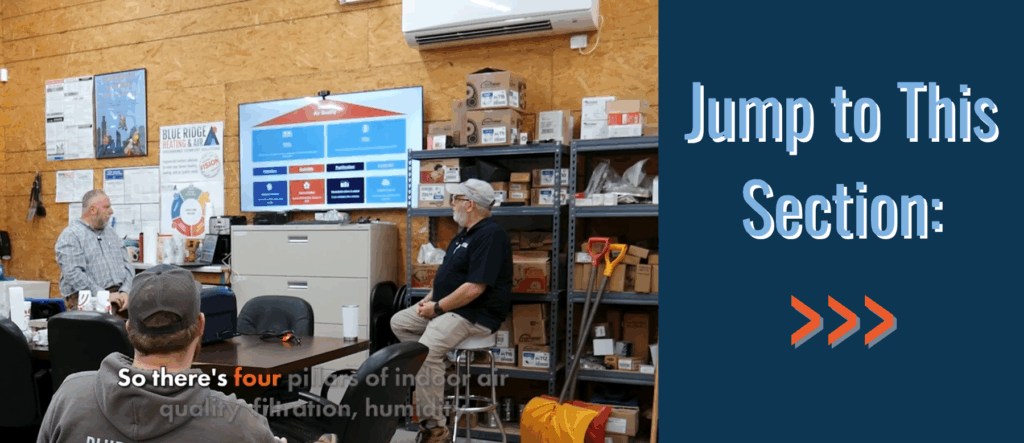
The Four Pillars of Healthy Air
Blue Ridge focuses on four key elements of indoor air quality: filtration, humidity control, purification, and fresh air ventilation. Together, these create a complete system that helps your home “breathe” the way it should.
1. Filtration: Your First Line of Defense
Your HVAC filter does far more than trap dust, it protects your system and your lungs. High-efficiency filters (MERV 11 and up) can capture up to 95 percent of pollen, mold spores, and pet dander.

“A clean filter equals less strain on your system and cleaner lungs,” – Pete
For most homes, filters should be replaced every one to three months, depending on your environment. If you have pets, live on a dusty road, or notice buildup around the vents, monthly changes are best. Blue Ridge also installs whole-home filtration systems such as the Aprilaire Healthy Air System, which uses MERV 13 media filters to capture even microscopic airborne particles.
2. Humidity: The Balance Between Comfort and Health
Humidity control plays a huge role in both comfort and protection. When humidity climbs above 55%, it creates the perfect environment for mold, mildew, and dust mites. When it drops too low, you can experience dry skin, nosebleeds, or even warped hardwood floors.

Dry air is easier to cool than damp air which is why keeping humidity between 30-50% year-round is key. Blue Ridge installs both whole-home humidifiers and dehumidifiers, including advanced Aprilaire models that can be tied directly into your HVAC system. These systems automatically regulate indoor moisture and even recirculate water efficiently, saving up to 70% compared to older models.
3. Purification: Taking Clean Air to the Next Level
While filtration catches the visible dust, purification tackles what you can’t see (viruses, bacteria, smoke, odors, etc…). Whole-home air purifiers like the REME HALO® and HALO-LED® use UV light and ionization to neutralize contaminants right inside your ductwork.
The LED versions are energy-efficient, mercury-free, and can inactivate up to 99% of airborne pathogens, including COVID-19. Some homeowners even notice a fresher “clean air” scent after installation.
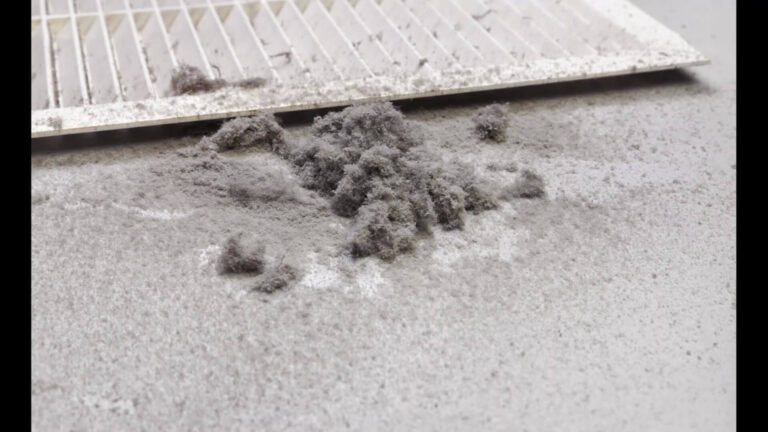
There’s one temporary side effect worth noting: new ionization systems can cause a little extra dust to settle in the first month or two, and that’s simply because they’re doing their job pulling particles out of the air.
Fresh Air: Letting Your Home Breathe Again
Modern homes are built tightly to conserve energy, but that also means stale, recycled air often gets trapped inside. Without proper ventilation, carbon dioxide and chemical pollutants build up, leaving the air feeling stuffy or even making you tired.
That’s where energy recovery ventilators (ERVs) come in. These systems bring in filtered outdoor air while exhausting stale indoor air, all without wasting energy. The result? A steady exchange of fresh, clean air that keeps your home comfortable and balanced year-round.
A New Way to Detect Problems: Mold Sensors
One of the newest tools Blue Ridge is offering is the Air Guard Mold Sensor, developed by one of the company’s own owners. These innovative devices monitor humidity, temperature, and even the gases that mold gives off. It then warns homeowners through an app when conditions are right for mold growth.
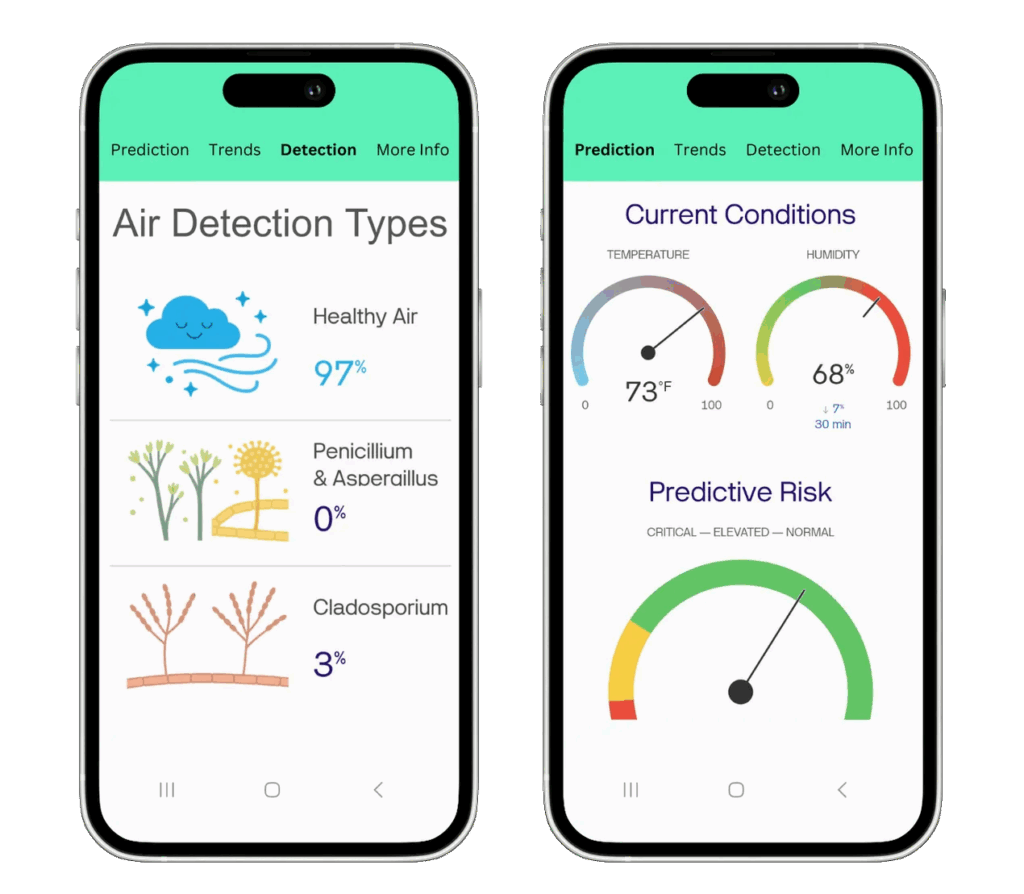
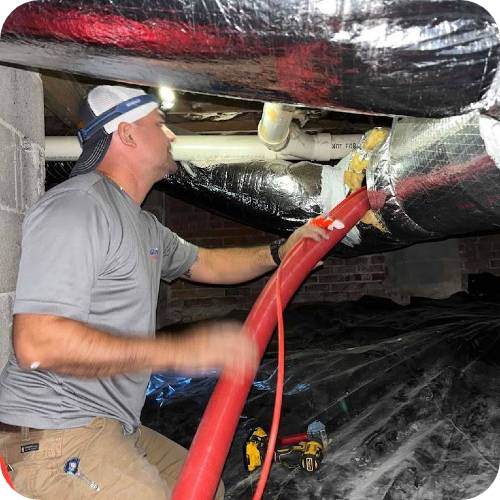
Technician Nate shared a recent success story: a pilot program member’s mold sensor detected hidden growth in the ducts long before it became visible. When the team inspected the crawl space, they found extensive contamination. Thanks to the early alert, Blue Ridge was able to replace the affected ductwork and prevent further spread.
Small Changes, Big Impact
Indoor air quality isn’t just about fancy equipment, it’s about daily habits. Replace filters regularly, keep vents unblocked, schedule annual maintenance to clean coils and inspect ducts, and if your home feels humid, dusty, or stale, have a professional test your air quality.
“We spend up to 90 percent of our lives indoors. Clean indoor air isn’t optional, it’s essential.” – Pete
Need help keeping up with maintenance? Our Blue Ridge Comfort Plan includes two annual tune-ups, priority scheduling, repair discounts, and more to protect your HVAC investment.

Final Thoughts: Breathe Easier with Blue Ridge
Whether you’re dealing with humidity, allergies, or simply want a healthier home, Blue Ridge Heating & Air has solutions that fit your space and budget. Our team can assess your home’s air quality, recommend filtration or purification upgrades, and ensure your HVAC system supports your health year-round.
Heating and Cooling Issues? Click Here!
📞 Take the first step toward cleaner air today!
Schedule an indoor air quality consultation with Blue Ridge Heating & Air. Your lungs (and your comfort) will thank you.
✅ Get a quote
✅ Get it done right
✅ Sleep better
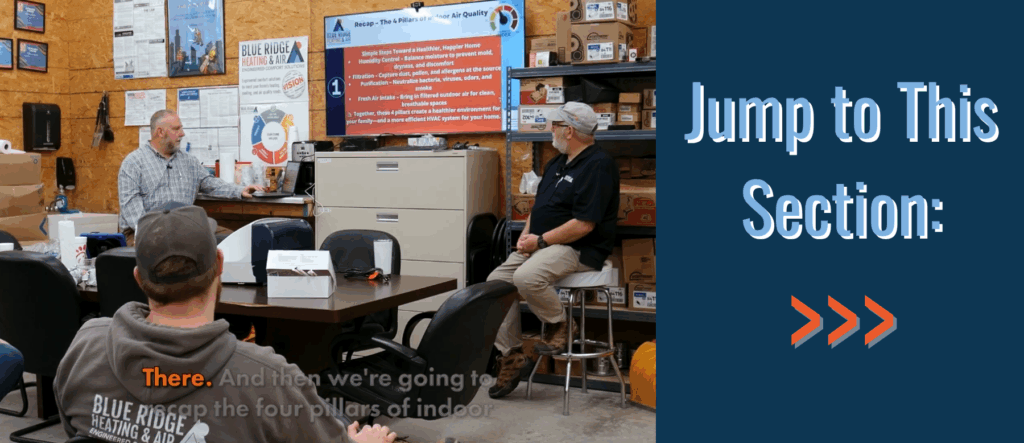
Indoor Air Quality Seminar: Transcript
Pete: Alright, so indoor air quality seminar today! Created by Baily here with the camera and Brian who is the technical genius of all this.
Brian: That’s scary.
Pete: I’m a pretty face and narrator. I’m proof that we’re an equal opportunity employer. Baily’s got us a good Chinese proverb here, “when the winds of change blow, some people build walls while others build windmills”.
So what is indoor air quality? We call it IAQ for short. And why should you care about the air that you breathe indoors? IAQ or indoor air quality refers to the condition of the air inside your home or your business. It includes the humidity levels, airborne particles like dust, chemical pollutants, and ventilation. According to the EPA, indoor air can be two to five times more polluted than outdoor air, and in one of our slides it even says 10 times more. So it can be pretty nasty inside if you don’t take care of it. Poor indoor air quality has been linked to allergies, asthma, fatigue, dry skin, illnesses, and even long-term respiratory issues. With people spending up to 90% of the time inside their homes, clean indoor air is essential. It’s not optional. And we’ve had customers where we’ve went to their house where the wife was suffering with some really nasty asthma and respiratory issues, and went to look at doing duct cleaning to see if we could help, but ended up having to go in and do a lot more just to remedy her situation.
So there’s four pillars of indoor air quality, filtration, humidity, purification, and fresh air. Through filtration, we talk about airborne particles like dust, pollen, smoke. When we talk about humidity, we talk about comfort. The more humid a house is, the more musty it feels, the more hot it feels in the summer. When we talk about purification, we talk about everything from all of that dust and contaminants to even smells. You know, we have some purification that can get rid of smells pretty quick. So burn popcorn: we got the remedy. Then we also talk about fresh air because a lot of times we go into homes, uh especially newer built homes. They’re really built really tight for efficiency’s sake, and then there’s been this latest fad where folks think it’s a good idea to do spray foam insulation in their attics. And that really makes it hard for their homes to breathe.
Brian: It’s a closed cell spray foam or stuff, and it also puts off a smell and it makes it real tight. So it’s good insulation, but at the same time, the house is not breathing like it used to.
Guest 1: And so it flashes off the plasticizers and everything from its manufacturing process.
Pete: So we have remedies for that as well. So Blue Ridge is four pillars of indoor air quality filtration, like we said, humidity control, purification, and fresh air ventilation. With filtration, we’ve got some pretty strong air filters, Merv 11 and up. What is the Merv level like in doctor’s offices, hospitals and all this?
Brian: I’m not real sure. I don’t want to give you a number, but we have some customers that have hospital filtrations in their houses. So I don’t have an answer for you.
Pete: Right. And HEPA filters with humidity control. We know we try to keep it between 30 and 50% humidity. When it gets too low, it can cause nosebleeds, dry skin, can really damage some hardwood floors or some musical instruments in the home. But when it gets too high, it can cause some difficulty breathing. It helps…
Brian: Door swelling.
Pete: Door swelling. And it also just makes the home more uncomfortable and harder to cool. Dry air is easier to cool than damp air. And then we’ve got fresh air ventilation where we can, you know, on those really tight homes, we can take fresh air from outside and bring it inside to give you some fresh air and bring those carbon dioxide levels down.
So, any questions so far? All right, we’ll move on.
Brian: I’ll show you some products. Over there, we have the Mediair filter that he was talking about for filtration, the one on the right with the Blue Ridge. Right next to that, we have a dehumidifier for removing moisture in the air. We can put it in the basement. We can hook it up to the duct system. So you’ll have a whole house dehumidifier and it really helps with drying out the air in the house. Here we have a humidifier buried by the biscuits to add moisture to the house. And then right there we have the UV lamp to help purify the air. One of the biggest causes that he didn’t touch on was paint cans, gas cans. We all have them in our basements or in a crawl space where they’re putting off smells and chemicals that we are breathing. Another thing to look around, what is that gas that puts off on the rock? Radon. So we have that as well around here.
Guest 2: This thing here, Helio something or other, how long has that been around?
Brian: Since about 86 as one of the manufacturers I was looking at today.
2: How long are they affected once you have them installed?
Brian: They last, the light bulb LEDs last five years. The other bulb last three years, I believe.
2: Is it difficult to change them? I think I’m due for a change.
Brian: I don’t think they’re very difficult now. Earlier days they were difficult. They had to be real careful with them. You couldn’t touch them or anything like that. But you, these seem like they’re very easy to change out.
2: Is it expensive to replace?
Brian: I do not know the prices on those things.
1: Is it ultraviolet?
Brian: Yes it is.
Pete: And this one here is also an ionizer.
Brian: That is correct. As air goes across it, it ionizes the air and puts a negative charge into the air, what helps the dust particles come together, which in there, it helps the filter catch it down the road.
1: I have a question about filters. I’m sorry. The more effective the filter, does it make the unit work harder?
Brian: In some cases, yes. So the thicker the filter and as air stops, excuse me, as the filter gets stopped up, the air is going to get in there some way. So it’s going to start pulling it from other places. If you ever pull your filter out of the wall and you look and you have dust around the filter, that means the dust is getting around the filter. You may want to use painter’s tape to seal it up. Also, as the filter gets stopped up, the system has to run harder. The filter is really there to help the system, to keep the system clean. But if the ductwork behind the filter is not sealed, it’s gonna pull from the crawl space, it’s gonna pull from the attic, wherever you can get the air to help. And if it’s not getting the air, the system’s gonna run harder and become more inefficient.
Pete: I think her question was like say the four inch filter there. Would it make the system work harder than say the one inch filter that I can get it?
Brian: Only because if you look at the area that you have, this has more area for the air to go across. So that’s what helps this in that situation. The one inch filter does not have all that area to cover.
2: So we have one inch.
Brian: Yes. Now these could be installed on the like underneath the duct work there or in between the duct work and the system.
Pete: Remove the hand trucks here.
Brian: So that’s where the more surface area helps in the air flow.
Pete: Just pull it out.
Brian: And it looks like it’s crushed in there, but that’s for the door to get close to the door. So the air is not getting around the doorway as well.
2: Thank you
Brian: So, go ahead, Pete. I’m sorry to interrupt you.
Pete: No, no, no, we’re doing, we’re team, teammates, man. This is the dream team here. All right. So filtration, your first line against airborne allergens, high efficiency filters like Merv 11 or HIPAA filters capture pollen, dust, pet dander and mold spores. A clean filter equals less strain on your heating and air conditioning system and cleaner lungs. We recommend checking or replacing your filter at least once to every three months, really depending on the usage and the environment. Some places are more dusty, we need to do it once a month. Some places, every three months is great. Custom filter setups are available through our comfort services. The big filters like those, sometimes you don’t have to change them but twice a year.
Brian: Six months to a year. It all depends on the activity in the house. Do you have dogs, cats, kids? Is the house on a dusty road? And sometimes it’s a year.
1: Are those filters like the Merv11, is that in place of your cold air return filter or is that in addition to the cold air- the existing cold air filters that you have?
Pete: We put it in place of.
1: In place of?
Pete: Yes.
1: So if you had it in a wall, you would replace that unit with one of your units. Would it fit the same thing or would it have to be modified?
Nate: The filter system would be at the unit. We’re not replacing the grill on the wall. That’s what you’re asking.
1: Would you have that in addition to it or would you eliminate it?
Nate: I would not recommend it just because the double filtration would have too much strain on the system. oh I mean, I guess, could you put a cheapie?
Brian: You could just to keep the bigger particles out of the duct system, out of the duct system going to the unit. Now that would take care from the unit, really protecting the unit, keeping the dust off the coil and the blower motor. So you’re not losing efficiency there.
Nate: Yeah. So you can put a very, very cheap filter just to catch. The big stuff.
1: Now what about the HEPA? Where does the HEPA unit go?
Brian: In similar places like that unit there.
1: At the unit itself.
Brian: Yes, sir.
1: OK. Thank you.
Pete: So our solutions, we’ve got the AprilAire Healthy Air System Cleaner, which is what he has there, what we have there in the unit, utilizes a MERV13 filtration system, catching 90% of airborne particles. Those are one to three microns in size. 95% of pollen, mold spores, and pet dander, and 99% of airborne viruses and bacteria when combined with purification and humidity control. It eliminates the need for those portable air purifiers and it’s a very low maintenance. You only need to replace these filters like once, maybe twice a year. So it’s perfect for families where you have someone with allergies, asthma, pets, or anyone who just wants to have cleaner, healthier air.
Now let’s talk about humidity. The house can be too humid or not humid enough. Balance indoor humidity should stay between 30 and 50%. Too much humidity fosters mold. I think the EPA says over 55% humidity is conducive for mold to grow. And it also helps bacteria live and thrive and dust mites as well. So humidity levels under 50% make mold and dust mites go dormant. Blue Ridge offers whole home humidifiers and dehumidifiers to maintain the proper moisture control year round to keep you comfortable so you don’t have the dry skin or the irritated sinuses and the static electricity. Who loves to walk across the carpet and then really pop your wife when you give her a kiss on the mouth? So a fun fact here that Bailey gives us, crawl spaces in basements are key battleground for moisture problems here in the Carolinas. um There are times when we go into crawl spaces and it’s almost raining in there, it’s so humid. So crawl spaces are, we have solutions to dehumidify and seal up crawl spaces to keep that area clean as well, which will keep your house as well more comfortable.
So our solutions for humidity, we’ve got the Aprilaire dehumidifier, which removes excess moisture. It prevents mold, mildew and dust mites. It’s ideal to just be a standalone in basements, crawl spaces and whole homes in general, or we can put it in conjunction with the heating and air system. And Brian can tell us more about how we hook those into the ducting system. It all generally goes into for dehumidifiers in the return side and for humidifiers in the supply. Is that right?
Brian: Sometimes humidifiers go into, they’re called a bypass. You hook them up to the supply and they return. This one here just hooks up to the supply, has a blower on it. The thing I like about this one here is new to the market, that it recirculates the water before. It saves a lot more water. I think it’s up to 70% where the old humidifiers just ran through whatever it didn’t use. It ran right through. So this will recirculate the water, make it more efficient. So I really am pleased with that. We’ve installed a few of these so far and the customers are very pleased with them. These will put out about 21 gallons per day, where the other ones are like the bypassers, like 12 to 17. I can’t remember the numbers. These really help with humidifying the air. Especially hardwood floors, we see them start to buckle or dry out and separate. So the dehumidifier is right there. We would hook them up to the sub-return and they have to be six feet apart so you’re not recirculating the air within the dehumidifier and the duct work. With that, we like to tie them into the system. So when the dehumidifier calls for dehumidification, the blower comes on and recirculates it through the house. So this way you’re getting dehumidified air throughout the whole house.
Guest 3: That doesn’t have a blower. It uses the one in your…
Brian: It does, but it’s dumping it into the system, which the system is dispersing it. So they work together.
3: When you have a humidifier, so there’s water in there. What’s to keep mold and bacteria growing in that moist coils or whatever is in there. I mean, does it have a…?
Brian: It has a panel that needs to be changed once the season. So and they have to be serviced. The maintenance is not a hard maintenance, but it’s it’s a big biggest area. It’s overlooked.
3: It’s a scene. So it doesn’t have like a UV that’s doing anything in the water.
Brian: No, it does not. But you can have the UV with that and taking care of that. So servicing them, making sure that panel’s changed every season is critical.
Pete: Now let’s talk about purification. We take clean air to the next level. Air purifiers remove what the filters can’t, like bacteria, viruses, smoke, and odors. Options like the UV light here and PCO technology neutralize airborne contaminants at the molecular level. Our systems have shown up to 99 % inactivation of airborne pathogens, including SARS and COVID. Ideal for homes with kids, seniors, allergy sufferers or pets. They’re very effective and they also keep the unit clean inside as well, which helps it last longer. Did you know that whole home purifiers integrate directly into your existing heating and air conditioning setup? And these are generally installed where in the system, Brian?
Brian: You look up there in the supply duct. It’s over there. I don’t know if that pipe is blocking it.
Pete: It’s blocking it from them.
Brian: But that pipe is bringing in fresh air from outside and right behind there is a uh UV lamp. So I just put it right there in the supply plant. I’m gonna go from, and it works real well.
Pete: And as air passes over the UV light, kills the germs and ionizes the air. And so our solutions here, have the Remy Halo, which is an active purification using UV light and advanced oxidation, reduces airborne viruses, bacteria, mold, and volatile organic compounds, which are like say in your building materials, could be in your linoleum, carpet, wallpaper, um and then also from like the cooking stove, candles, not so much candles, I don’t know, but like. oil burning lamps or propane. It’s installed into your ductwork for full home coverage. We have the halo LED. So we’ve got two different versions of this. We’ve got one with, it’s like a of a bulb like that. And then we’ve got the LED um zero mercury energy efficient LED technology, longest lasting, low maintenance in duct air purifier. Ideal for energy efficient and allergy sensitive homes. It matters because it neutralizes up to 99% of the airborne contaminants, tackles odors, smoke, germs, allergens, and it’s safe. It’s always working behind the scenes so you can have that peace of mind knowing that you’ve got another defense.
3: So what’s the pluses and minuses of the two different systems?
Brian: I don’t have a good answer for you, but I think… em I like the LED. It oh only runs when the system’s on, so you’re saving power. Not a lot, because it doesn’t use a lot of power, but at the same time. It works. I like the longer life span, the three to five years. But at the same time, the other one is keeping that ductwork sanitized as well. Yes, and it’s working all the time. So that is a real plus as well. Whatever way you want to look at it.
Nate: If you’re in the house half, you know, half of the half the year. having something that’s just tied to the unit where it cycles on and off is probably better. If you’re there at the house the whole time, then you may want the one that’s constantly on to get more life out of it.
1: And we talk, did we talk about this? Is that battery operated or AC?
Brian: AC. It’s tied into the low voltage system of the equipment. It has its own transformer. So, and it’s being energized and its wires are tied into the system.
Pete: About ozone, one of these has uh more ozone.
Brian: Depletion or…
Pete: Doesn’t it make ozone or give an ozone smell?
Brian: I believe it’s the LED.
Pete: So gives you a cleaner smell in your home as well.
Brian: It’s a peroxide that is putting out where it’s cleaning the air and cleaning surfaces. So and I believe that’s the LED.
Pete: Now you asked about a downside. One thing like newly installed these ionized air so the air the dust clumps. So I’ve heard a couple of folks say like the first month or two they’re having to light dust off a little bit more because there’s more falling out of the air. But the way it’s better on the furniture than in your lungs. But after a while that remedies itself and-
2: Provided you keep the doors and windows closed.
Pete: Right. and not bring it all in. Any other questions?
All right, we’ll move along to fresh air. Because breathing recycled air just isn’t the same as fresh air. Modern homes are airtight, great for efficiency, but not great for ventilation and when some of us who are used to it, when we go into a house, we can tell that they’ve sealed it up pretty tight, because you just, it’s just a little different breathing there. And they’re really tight and it just smells and… tastes and feels different. So they need fresh air systems like the ERVs, energy recovery ventilators, to bring in filtered outdoor air while maintaining energy savings. It really helps reduce carbon dioxide buildup, indoor pollutants and that stale air feeling, essential for the healthy airflow and balanced indoor environment. So fresh air plus ventilation plus purification gives you the gold standard in air quality.
Brian: We don’t have one of those air, but we have installed them in quite a few houses. Sometimes they’re installed in doctor’s offices where their houses are tight and they’re just changing the air so many times an hour. So they have a core inside there where so I’m bringing in cold air. It goes across the air that’s being exhausted and it picks up the heat or the cool air from inside the house. before it discharges in the house and discharges outside.
1: So how does that differ from a makeup air system?
Brian: Sometimes a makeup air is just bringing in outside air. Say if you have an exhaust hood over 400 CFM on over the range, it requires that you bring in fresh air. The fresh air is just coming in. Whatever the temperature is, being dumped into the house or into the system, whichever application you have.
Pete: So when it’s 20 degrees outside…
1: …you’re bringing in that 20 degree weather.
Brian: Hot and humid outside? You’re bringing that hot humid air inside. Whereas our ERV puts it through the system to condition it first.
1: If you get that ERV system, can you get rid of that make up air system?
Brian: No.
1: So you still have to buy from that make up air system.
Brian: And the reason why is the ERVs don’t bring in enough volume of air when you turn that exhaust fan on full speed.
Pete: So our solution with our energy recovery ventilators, it brings fresh air without wasting energy, brings filtered outdoor air while exhausting stale outdoor air. Now, Nate and I have been to a house once where the guy had, he just took a dryer vent and drilled a hole into his return and ran that all the way out to a hole in the side of his crawl space. So he’s bringing all that in. It was so nasty inside of his return. and he was talking about smells in his house and that was why he did a little engineering there. So you can do your own kind of thing, but it’s not recommended because he tore his $15,000 heating and air system up by bringing a lot of dirt in. So filter it. Balances indoor humidity and temperature for comfort and efficiency. It helps reduce indoor pollutants like carbon dioxide levels and that stuffy air. Ideal for tightly sealed, energy efficient homes. Very quiet operation and integrates with your heating and air systems. Ensures your home gets the fresh air it needs without the energy loss. Any questions there? I beat the punch there.
And then we’re going to recap the four pillars of indoor air quality. Simple steps towards a healthier, happier home. Humidity control, so balance the moisture to prevent mold, dryness and discomfort. Filtration to capture the dust, pollen and other pollutants. Purification to neutralize the bacteria, viruses, odors and smoke. And then fresh air intake to bring filtered fresh air in and get the stale air out. And together all these four create a healthier environment for your family and a more efficient HVAC system for your home. That’s all!
Brian: One thing I want to bring up that is new to us. One of the owners designed this. It’s called a mold sensor. Nate will come up and give you more ideas about it because he’s installed them. He’s worked with them. He’s been, how long you been installing these down in Greenville? September. Okay. They even have a patent on them too. So Chris, one of the owners designed this and came up. So come on up here and let you look at this or talk about this. And I’ll give you this so it’s recorded. And touch on uh duct cleaning, please.
Nate: Yeah, I got you. So basically what this does is it, you’ll have an app on your phone and it will tell you predictors. So humidity, temperature of the environment that the mold sensors in and it also registers the gases that the mold puts off. So that musty smell is mycotoxins, which is gas that it’s raw gas the mold puts off. And so this is able to register the gas itself. I mean, this is a one of a kind uh piece on the market. No one else has anything like it. uh And so I’ve I’ve been partnering with a mold inspector down in Greenville, who’s actually, he’s done stuff as up here in Lake Toxaway and whatnot. His name is Mike Reakey. And so we’ve partnered with him on this, just kind of have an outside verification like that, hey, what we’re actually seeing or picking up on is correct. So I partner with them, I take a mold test that will then, this will have a database to pull from and I’ll compare it with what the traditional mold testing that Mike will do. And then we get third verification by sending it to a microbial lab. Then they will confirm what we’re picking up. So, we’re not just, yeah, this is this, this is that. No, I’ve got two points of verification that is not part of our company to verify that what we’re actually picking up is the real deal. So I recommend having one in the basement, the high humidity, one in the basement, one in the crawl space if you have that, one in a living area, just so you have kind of a control environment that, hey this is, you know, maybe you’re breathing stuff that you don’t know about. And then. Yeah, just the office in the return. OK, yeah. So this this is an example of the app. So you have predictions that shows the current temperature. The humidity is 51 percent. It predicts the days to biological growth.
Baily: Now, like I said earlier, we have a video I just it’s a draft, but it is Chris’s house. It picked it up, and you can see the mold. Once we popped it open, it’s pretty cool. But mold is obviously gross.
——————————————–
Video: We are in a customer’s crawl space right now and they were one of the pilot programs for the mold sensors and the mold sensor in their living room started triggering mold growth. So we came out and the flex ducts coming off the unit, you look inside. A lot of growth in there. And you can tell it’s not dust because dust naturally falls to the bottom and you’ve got growth on the top. And it’s textured so you know it’s not dust. And it’s all camouflaged. That’s another clear sign it’s mold. and it’s in all of these lines coming off of the unit. And if you look, you have a UV light here, but the light, the LED light is not on, so the bulb is not on. So we don’t know how long this light has been out, but that may have contributed to the mold. And so what we’re doing is we’re gonna be replacing all the duct work in the crawl space to just get completely get rid of the mold and there some of the ducts are going into the basement on the other side of the wall here and that’s all metal so we’re going to clean and sanitize that and that should be good, but everything else in the crawl space we’re going to replace. So clearly you can see that the mold is just off the charts here and that validates the mold sensor that was triggering it inside because this runs and feeds the air to where the sensor was. So this is picking up all of this growth and that’s just not good. So yeah, we’re gonna replace all this, clean what we can. Now if you didn’t have a mold sensor, you wouldn’t have caught it. The mold sensor triggered and we came out and we did mold testing with, uh we did our mold testing and then we had a third party come out and do their own mold testing to verify that what we’re picking up is actually true. And that’s when I also, I took these lines off and saw all the mold on the duct work here. It just kind of, visually verified what the testing was doing and just more confirmation that the mold sensor works and that the duct works need to be replaced down here. So I’m going to take that auger and run it through because our standard brush and hose won’t fit. So I’m essentially just knocking everything down and pushing it to the main and then we should be able to access the main downstairs by the garage there. Yep, so we replaced all the nasty moldy duct work and the old insulation and we’ll continue to monitor with the Air Guard. But hopefully that should alleviate all the high mold levels that we saw. That’s it!
——————————————————————–
Nate: So yeah, that’s, I mean, that was just the local testimony of the air guard catching. Yeah, the owner’s house is the worst. So I actually took a section of that duck that was moldy and I took it to a microbial lab to get it tested, see what came back. But yeah.
3: But even with the soft ducting, you can run the brush? It can just knock everything down and then just vacuuming at the same time?
Nate: Yeah. Let me grab that brush so can feel the bristles. It’s pretty, it was not going to damage the duct. Like at the, is it at the return where you change the filter? There is an insulation board that sometimes people use like at the unit that looks like styrofoam. Okay, then that’s called duct board, fiber board. Yeah, that will clean, that’s not going to damage it. There is another brush that has like these… blue bristles that are harder so we’ll send that through metal and that it kind of if this is a bit soft the blue will help make sure we get everything so that’s yeah.