In this episode, Chris Davidson, owner and operations manager at Blue Ridge Heating & Air, explains why the company offers Armstrong Air furnaces and heat pumps for Brevard-area homes. He discusses furnace and heat pump features, warranties, system sizing, line-set cleaning, testing and commissioning, electrical protection, and how to compare Armstrong Air models by comfort, efficiency, and budget.
John Maher: Welcome to Clearing the Air, the Blue Ridge Heating and Air podcast, where we help homeowners in upstate South Carolina and Western North Carolina make smarter, more confident decisions about heating, cooling, indoor air quality, and whole home comfort. Today I’m with owner and operations manager, Chris Davidson, and our topic is Armstrong Air Furnaces and heat pumps in Brevard, North Carolina. Welcome, Chris.
Chris Davidson: Oh, thanks. Thanks for having us, John. Appreciate it.
Why Blue Ridge Offers Armstrong Air in Brevard
John: Absolutely. Chris, what led Blue Ridge Heating and Air to offer Armstrong Air furnaces and heat pumps, and what makes the brand in particular a good fit in the Brevard area?
Chris: That’s a good question. I think it was a few years ago we were installing a competitive product to this that we really were just struggling with a lot of callbacks just to the nature of the reliability of those units. Being in the reliability field myself, we started to study systems that were out there comparing, not so much the reliability information, but the customer satisfaction information between systems. So we did a detailed comparison there and found that Armstrong had a pretty good product.
As you dig farther into it, Armstrong is made in South Carolina, so we felt like it was a good fit for our customer base. And then the dealer that we partner with has helped us get really good warranties on Armstrong. So we felt like it was a good product that was going to work really well for the customer. So we’ve been able to get, say, 5 year unit replacement warranties, 10 year unit replacement warranties on some of the high end systems.
So that’s pretty good. If an outdoor unit fails within the first five years, the company will provide a new outdoor unit and then we can replace that versus just replacing components. So it’s been a pretty good product for us and pretty reliable out in the field.
Armstrong Air Furnace Features for Comfort and Efficiency
John: Absolutely. And depending on the model, what engineering features in an Armstrong Air furnace have the greatest effect on comfort and efficiency?
Chris: That’s a good question. I mean, a lot of them are very similar. I think what’s interesting with say an Armstrong Air Furnace is they’ve got a good heat exchanger, they’ve got a two stage furnace that does really well. They’ve put ECM blowers in those furnaces to help lower the cost. So it’s just overall a pretty solid product that’s kind of put together pretty well, relatively simple too, which is good. So there’s not a ton of parts in there that are complicating things. So it’s relatively maintainable for the technician to work on and then pretty robust from a reliability standpoint. So that’s really why we like it. The overall integration of that Armstrong furnace is pretty good.
Armstrong Air Heat Pump Performance in Mountain Weather
John: And then what about on the heat pump side of things with an Armstrong Air heat pump? How does that help to provide efficient cooling during the humid summers that you have in Carolina and dependable heating during those cold mountain winters?
Chris: Yeah, I think Armstrong has got a pretty solid heat pump. It’s very simple in nature. So once again, easy to maintain, easy to repair. They have a good single stage product that’s got really good efficiencies. They have an inverter product that seems to be really robust, but it’s a very, very simple product, pretty straightforward to install. The teams like installing them and then they seem to hold up really well.
And the beauty of it is we’ve had some pretty good interactions with the Armstrong engineering team if we run into some sort of hiccups and we’ve been able to work through with some solutions for the customers. So it’s been a really good relationship with Armstrong.
Proper Sizing and Installation for Armstrong Air Systems
John: And then whether or not you’re installing a furnace or a heat pump, what are some of the things that you do to make sure that that system is properly installed and is going to be working well for a long time to come, doing any kind of system commissioning and testing and design work and things like that, just to make sure that that installation goes well?
Chris: That’s a good question. I mean, we’ve talked before about doing heat loads for the home, making sure the system’s properly sized. We have a process that we use to clean the line set. So it sends a projectile through the line set to actually clean the inside of that. And that’s critical for removing any sort of maybe debris that’s in there. Or if the compressor had a burnout, if there’s acids that are floating around in there, we want to get that properly cleaned out and flushed. So that’s something that we spend time doing.
And then it’s pretty straightforward to wire up, so it’s been pretty reliable there. And then just when we install it, it’s a pretty straightforward install for the team, not super complicated. A lot of the systems don’t have a lot of bells and whistles on them, but they’re just kind of a good solid workhorse, almost like a work truck, and they just turn on every day and they just keep running. So it’s been a good product for us.
Testing and Commissioning an Armstrong Air System
John: What kind of testing do you do immediately after it’s installed just to make sure that everything’s working properly?
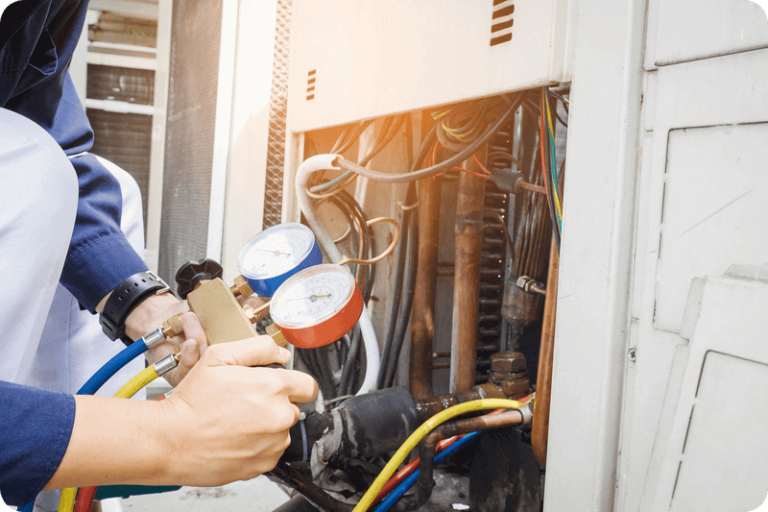
Chris: That’s a good point. In the summer when it’s hot, we have a set of psychrometers where we can measure temperature and humidity. We’ll put one on supply, one on return, look at how it’s performing. And then we also will look at the pressures that the unit’s under to make sure we got the proper sub cool or that determines the charge for the unit to make sure that’s all squared away. Also look at maybe some voltage readings to make sure everything’s squared away there.
If we have an inverter system, which is a little higher tech system on some of the higher end Armstrong’s, we want to make sure we’ve got some protection there and the voltage for the homeowner’s not above that, say 253, 255 volts coming into it. And there are homes out there, especially on the end of the grid, like if you’re way out in the woods, or we’ve seen some really close to substations that have problems or some homes that are on solar that we’ve really got to watch out for and make sure that the voltage doesn’t get too high and fry those systems.
That’s probably the thing that can take systems out quicker than any, is not having proper protection and proper voltage going to it. So those are things that we’ll kind of look at when we commission that system to make sure that it’s properly functioning.
Comparing Armstrong Air Models, Efficiency, and Cost
John: Okay. And then how should a Brevard homeowner compare different Armstrong Air models based on their efficiency, their features, their operating costs? And how do you walk a homeowner through all that? Because obviously a homeowner doesn’t know nearly as much as what you do about the different Armstrong models and the different features and capabilities of them. How do you go about explaining those and helping the customer to pick the right one for their situation?
Chris: I think once again, the nice thing about Armstrong is it’s pretty straightforward. There’s really three models. There’s an entry level one, a mid model that’s a pretty solid workhorse. And then you got that high end model if the customer wants something like that. We just kind of walk them through that, walk them through maybe the thermostats or how that model is being controlled and make sure they’ve got something that kind of fits their needs.
If they’re super conscious about, “Hey, I need something super efficient,” you can walk them towards that 21, 22 SEER unit that’s got the high efficiency and help them move in that direction. But they want something that’s kind of like, “Hey, this will do a fantastic job for my home.” Maybe the 19V, which is going to be kind of that middle tier unit. And then of course you just got the workhorse, the single stage unit that’s going to be your entry tier unit, that just runs and stops and runs and just keeps going.
Easy to repair, relatively easy to maintain, not overly complicated. So those are kind of the three tiers that Armstrong has for the customers.
Higher-Efficiency Armstrong Air Options Over Time
John: Do you find that customers sometimes will start with that entry level tier and then they’ll realize, “Wow, I really like this product a lot,” especially with things like heat pumps that maybe they’re not used to that type of technology, and then they come back maybe some years later after that system has run its course and they’re saying, “Yeah, this next time I want to really bump it up and maybe get that middle or high tier because I’m really loving this product”?
Chris: Yeah, we’ll find that some customers definitely want to move in that direction. For a heat pump, maybe that 19V is a little bit better, gives you a little bit better, or maybe even higher than that. But if you’re super worried about efficiency, yeah, we’ll find some customers want to definitely move up that scale after moving forward.
John: All right, well, that’s really great information, Chris. Thanks again for speaking with me today.
Chris: All right, thanks for having us. Appreciate it.
John: And for more information, you can visit the Blue Ridge Heating and Air website at blueridgeheatingair.com or call us in the Greenville, South Carolina area at 864-485-6509 or in the Brevard, North Carolina area, call 828-415-3339.