Seminar Throwback: The 2025 Refrigerant Change Q&A
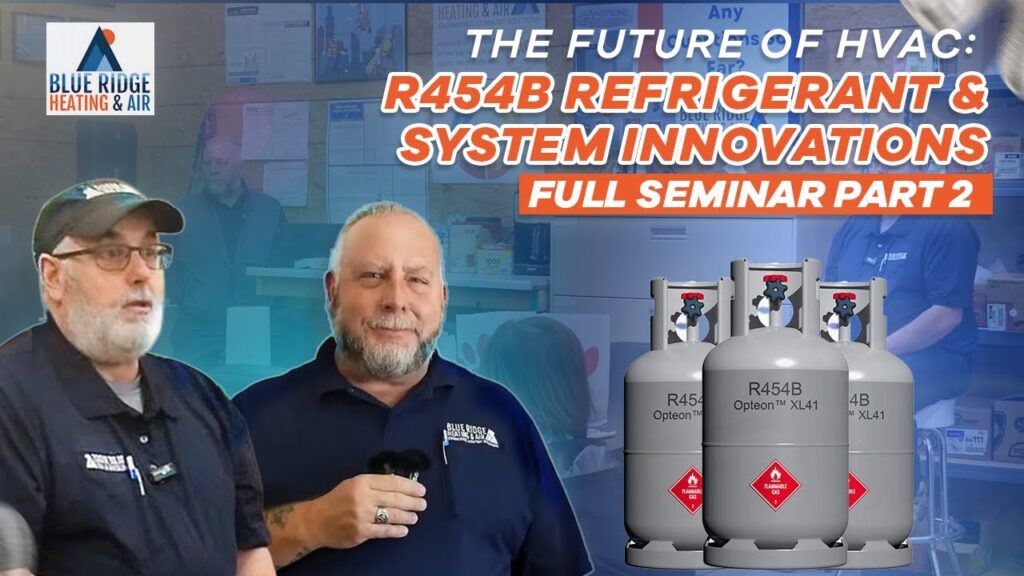
The HVAC industry is experiencing a major shift, and it officially began in 2025. Blue Ridge Heating & Air recently hosted a seminar to help homeowners understand what the new refrigerant regulations mean, why they’re happening, and how they impact your home system.
If you missed it, here’s everything you need to know.

Why Is Refrigerant Changing?
Starting in January 2025, heating and cooling equipment manufacturers must transition away from R410A refrigerant to a new, more environmentally friendly refrigerant called R454B (also known as Puron Advance or Solstice).
This change is part of a national effort to reduce greenhouse gas emissions under the EPA’s AIM Act, aligned with international environmental agreements like the Montreal Protocol.
Key Differences:
|
Refrigerant |
GWP (Global Warming Potential) |
Status |
|---|---|---|
|
R22 (“Freon”) |
1810 |
Phased out in 2010 |
|
R410A |
2088 |
Being phased out starting 2025 |
|
R454B |
466 |
New standard for 2025 equipment |
R454B reduces environmental impact by 78% compared to R410A, making it the refrigerant of the future.
Can I Keep My Existing R410A System?
Yes. If your current HVAC system uses R410A, you are not required to replace it. You can continue to use it until it fails or becomes inefficient.
- R410A refrigerant will still be available until at least 2036.
- Repairs on R410A systems can continue for years.
- However, expect the price of R410A to increase over time as production is reduced.
Can You Put R454B in an R410A System?
No, they are not interchangeable. R454B requires new compressors and compatible components. If you need a major repair like a compressor replacement in the future, you must stay with R410A or replace the entire system.

Is R454B Safe? What About Flammability?
Some homeowners are concerned because R454B is labeled A2L: mildly flammable. However, it has built-in safety requirements:
- Leak sensors are now required on systems using R454B.
- If a leak is detected, the system automatically shuts down circulation.
- There must be 925°F of open flame to ignite R454B — highly unlikely in home conditions.
- R454B is already used safely in Europe and Asia.
✅ Bottom line: It’s safe and industry-approved.

Should I Buy Now or Wait Until 2025?
This was one of the top questions we received during the seminar, and the answer depends on your priorities.
|
If You Buy Now (R410A) |
If You Wait (R454B) |
|
Slightly lower upfront cost |
10–15% higher cost for new systems |
|
Familiar technology |
New standard refrigerant |
|
Refrigerant prices rising over time |
May be early “kinks” with new tech |
|
Limited availability after 2025 |
Supported long-term |
Blue Ridge Heating & Air will carry R410A, R32, and R454B systems during the transition to give customers flexibility.
What About Efficiency Requirements?
Starting in 2025, SEER2 efficiency standards also increase. Minimum efficiency for heating and cooling equipment will rise to improve energy savings.
- Minimum standard: 14.3–15.2 SEER2
- Many modern systems are already compliant
- Higher-efficiency inverter systems and heat pumps may qualify for federal tax credits up to $2,000
What Equipment Works Best in Cold Weather?
Homeowners also asked how modern heat pumps handle extreme winter temperatures. Good news: today’s technology is far better than older systems.
Systems like MoovAir and Arctic Flex perform efficiently even in freezing temperatures:
- 100% heating capacity down to -4°F
- COP (efficiency rating) above 2.5 at very low temps
- Often don’t need backup heat strips except as emergency backup
Will My Existing Thermostat Still Work?
Yes, most thermostats are compatible with new systems. Only advanced communicating systems may require an updated thermostat, but 90-95% of systems will work with your current one.

Final Thoughts from Our Team
R454B may feel like a big change, but it’s a manageable and thoughtful industry transition. As Brian from Blue Ridge explained during the seminar:
“You don’t have to rush or panic. Whether you replace now or later, we’ll help you make the best decision for your home.”
Heating and Cooling Issues? Click Here!
📞 Have Questions About Your System?
Whether you’re considering replacement, thinking about refrigerant costs, or planning ahead, our team is here to help.
✅ Get a quote
✅ Get it done right
✅ Sleep better
Refrigerant Change Seminar: Transcript
Pete: Welcome to another Blue Ridge Heating and Air Seminar, “The Refrigerant Change of 2025, Part 2”. This is Brian Wilson and we’re going to go over the refrigerant change for 2025.
Brian: Before we get started, um one thing we’ll do is we’ll stop, ask questions, and then we’ll jump right back into it. We’d like to record this. So we’re going to, I’ll hand you a mic or Pete will hand you a mic so you can ask the question and we can hear it properly in the recording.
Pete: And for that or I’ll just redo the question that way they can hear that too as well whatever works. “Okay all right so Blue Ridge Heating and Air engineered comfort solutions some of y’all are current customers, and if you’re not we hope you will be soon. So what’s the deal with the refrigerant change?” So we’re going to go through, we’re going to slide through the deck here and learn as much as we can. Quentin Cook said, “if we are prepared, we shall not fear”. So this is a slideshow and information created by Baily Shannon here and Brian, and I am gonna be the presenter, and we’ll go from there.
“So what is R454B, also known as Puron, advanced or solstice? Well, R454B will commonly be used in the heating and air system starting in 2025. It’s chosen because it’s much better for the environment compared to the older refrigerants, having a lower potential to warm the planet. This change helps the industry meet the new environmental rules aimed at reducing harmful emissions.” When most people think of refrigerants today, most people say Freon will get called, hey, can you come and check my Freon? I think it’s leaking or can you charge up my Freon? Freon’s kind of the brand name. Refrigerant is what it is. Kind of like Coke is cola and Pepsi is cola. Freon is refrigerant. So some people call it Freon. Well, that Freon (R22), phased out in 2010. And the most common refrigerant today is R410A. A fun fact that Baily wants to give us another refrigerant, R32, will also be used in the new order, but isn’t as environmentally friendly as R454B. R32 will be found in some of the brands like Daiken and Goodman.
“So why is 410A being phased out and R454B being mandated to use in the new systems? Well, the EPA supports the transition to R454B as part of a broader effort to reduce pollution and create a healthier environment for our future generations. R454B is recognized globally for its lower carbon emissions, aligning with the scientific consensus and the goals of the Montreal Protocol to combat climate change. R454B has a global warming potential or GWP of 466. This is a 78 % reduction of the GWP compared to R410A, which is GWP of 2088. Another fun fact, 410A it’s the most common used refrigerant over the past decade, but R454B has been in use for the past several years in other countries.” So it’s not brand new, it’s been in use for a while. It’s just kind of new to us. So what questions do we have so far? All right, no questions so far. So we’ll move on.
Guest 1: Yeah, I have a question. How would we know what kind of gas we would have in our existing units?
Pete: So the question is, how would we know what kind of refrigerants are in your existing system now? Brian, you want to take that one?
Brian: Most of you will have a label on your outdoor unit and it will have the refrigerant and what the weight is that was installed from the factory in there. A lot of the 410A will have a pink sticker on there. Or even on the indoor unit, you’ll have a pink sticker or it’ll be labeled for such and such.
1: Would it depend on the year, the vintage of it and make or?
Brian: Not necessarily. In 1996, they started coming out with the 410A and at that time we were installing 410A and R22. That was the old refrigerant that phased out. And so in 2010, they stopped manufacturing the 22 systems, and you had to buy the 410A systems. At that point, you had to get the 410A. Now, some of the systems would be dry shipped in 2011, 12, 13, where they had no refrigerant in it, would match up with the R22 systems. Going forward, from what I understand, you will not be able to do that. 410A, or we will not be able to get any dry 410A systems. Systems say in 2025, 26, 27 you need something to replace your unit. They will not be any dry systems for the heat pump to replace them. There will be air handlers there’ll be other things like that, but they will not be any outdoor units like that.
1: So the pressure is varied enough that you cannot replace 410A with the new refrigerant? Can you replace 410A in an existing unit with a new refrigerant if you purchase a system or are they not compatible?
Brian: The compressors will not work like that. They’re designed for the 454b where they’re designed for the 410a the refrigerant are very similar but there’s something in the components that will not allow the pump.
1: The pressures are probably different.
Brian: Not that much for our torch 22 to 410A, it was like 50 to 75% higher. I don’t know if that’s exactly right, but along those lines, these pressures will be 2%, 5% depending on the area. Anybody else? Yes, ma’am? You won’t have to replace them at all until they die or they’re no longer feasible to replace or fix. You would be replacing them at that time. So you don’t have to do nothing at the time. R410A refrigerant will still be available, but like R22, the price went up very high, very quickly and that’s what we’re looking at. So I don’t know how high. It’s whenever the market goes up.
Guest 2: So Brian, you’re not going to be able to put the R454B existing unit unless it’s specifically designed for that refrigerant, right?
Brian: That’s correct.
1: So the old ones will have to get the old refrigerant as necessary until they die, at which you replace it with a 454 unit.
Brian: That’s correct.
2: Do they have a sunset clause or ruling now on how long they’re going to produce R410A or are they going to let the market deal with it and just keep charging people more and more for purchasing that 410A?
Brian: At the end of 24, you’re no longer able to manufacture 410A equipment. Now anything that was manufactured can be sold in 25. What I understand, in 26 you’re no longer able to do that. You know you have to install it in 25.
2: Okay but, excuse me, but is 410A going to be available? How long do they have a sunset ruling?
Brian: You’re talking about the refrigerants? I’m sorry I was going with equipment. Yes, I think in 2036.
2: 2036?
Brian: Yes sir.
2: At this point?
Brian: Yes. That’s 12 years, right now, 11 years sorry.
Guest 3: Which isn’t bad unless you just installed the unit.
Brian: Well, I think it’ll still be around. R22 is still around. So, and that’s been phased out since 2010.
Pete: All right. Moving along. Why are people worried about the flammability of the R454B?
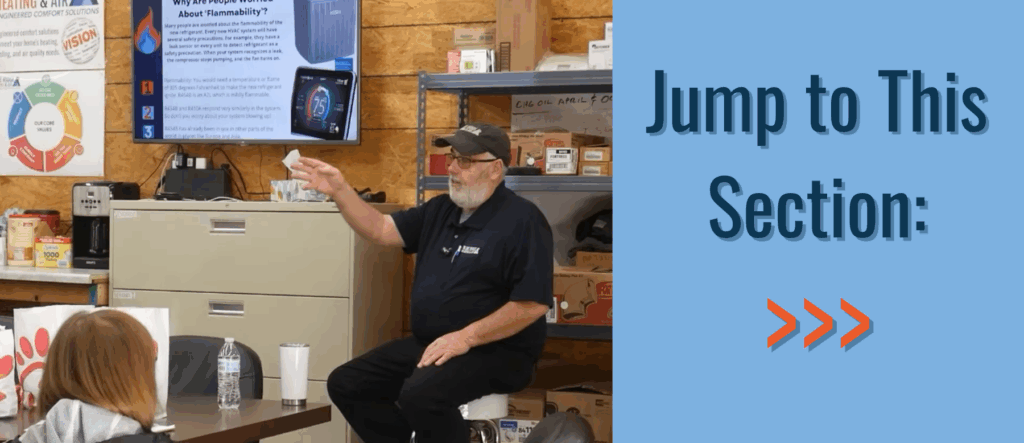
Many people are worried about the flammability of the new refrigerant. Every new heating and air system will have several safety precautions. For example, they’ll have a leak sensor. on every unit to detect refrigerant as a safety precaution. If your system recognizes a leak, the compressor stops pumping and a fan turns on. As far as flammability goes, you would need a temperature or a flame of 925 degrees Fahrenheit to make the new refrigerant ignite. R454B is an A2L which is mildly flammable. R454B and R410A respond very similarly to the system so you don’t have to worry about your system blowing up. R454B has already been used in other parts of the world in places like Europe and in Asia.
So a lot of questions we get is “should I wait to buy a new system or am I safe to purchase one now? Well, it’s completely up to you. It’s safe now and will be safe later. The new models in 2025, accommodating the refrigerant, the new refrigerant will cost about 10 to 15% more than what they do now. R410A will ramp down in production starting now and ending in 2036. So systems that use the R-14A will be able to be repaired and recharged through 2036. Installing a new unit today does not jeopardize your future of serviceability. And starting now, Blue Ridge Vans will also be carrying all three refrigerants, R-14A, R-454B, and R-32”, and other companies are also doing the same thing. So having to carry all three will cause prices on the refrigerants to go up. Part two, should I wait to buy a new system or am I safe to purchase one now? You will be fine with both waiting or purchasing a new one now. Here are some facts about the new equipment. New heating and air models are designed to be more environmentally friendly and may include innovative features to support R454B. Although they may come with a higher price tag and potential initial kinks, these models are technically similar to the other ones. ensuring reliable operation and comparable manufacturer’s warranties. Question.
Guest 3: I understand that the SEER rating, S-E-E-R, SEER rating on the new equipment coming out in starting in 2025 is going to be required, be a higher SEER rating than the existing not the existing, the low end, I’m not sure, you guys would know, 12 or 14 or something is not going to be available anymore. It’s only going to be a higher sear rating, meaning higher components, more efficiency. And can you comment on that?
Brian: Yes, it’s a SEER 2 rating. They’ve changed it from a SEER and they just went to sear two. So everything is geared toward being more efficient, saving on power, and things like that. Everything is going to be more, I think 14.4 is the minimum you can go and that’s a SEER 2 rating.
3: So that will be, that’ll comply with the new ratings that are only going to be available in the 2025 manufactured equipment?
Brian: Yes.
Mark: All the AHRI numbers out for the system. like when you take and you go from SEER to a SEER II, you got to have an AHRI match up for that. That’s –
3: That’s match up what?
Mark: An AHRI number and it’s just saying that both units are compatible, the outdoor and the indoor are compatible. That way the refrigerant has to match up the SEER rating and all those numbers will align inside the parium for the SEER II rating.
Brian: We just can’t put one piece of equipment with another and say they’re good. They have to have a number to go with them and that’s a government number AHRI. I don’t know what the terminology means but if you just go on their website you can see even with your own equipment just putting your own some of it may come up some of it may not because of how old it is?
Brian: So yes.
2: It seems like the weak spot of heat pumps has always been how low a temperature will they effectively operate with some reasonable measure of efficiency and obviously they get to the point where it’s low enough they’re just the same as resistance and you might as well go to resistance or some alternate system. What’s the best system you currently offer and how low a temperature can it go, say with a CLP of at least two or something like that?
Brian: Well, yesterday we installed this equipment, the MoovAir. It’s supposed to be five degrees. Is that correct?
Mark: It’ll go down to, it’s 100% efficient, down to minus four. The COP on that is rated at like 2.5 knots.
2: But that’s under optimal conditions. What’s the COP when you’re down five degrees?
Brian: That’s it.
Mark: That is it. That’s 3.5 knots.
2: So you’re getting three and a half times as much heat as you would from resistance heat.
Mark: That is correct.
2: At what degree temperature?
Mark: Minus, so this one, that unit right there.
2: Sounds too good to be true.
Mark: It does.
Brian: That unit right there does come with heat trips as well.
2: But why?
Mark: So if anything, you don’t have to have them. They’re not required according to the manufacturer. Logically for me if that outdoor unit was to stop working at any point, now you have the electric help to heat the house.
2: What about for defrost mode and so on? Don’t they usually use the strip heaters to help them defrost mode?
Mark: They do.
2: So if you don’t have them, how does that affect your unit?
Brian: The system, either the fan will shut off and it will go into defrost by itself. That system there, we had the door off yesterday and the fan did not come on because the air temperature was too low. As soon as we put the door on, the fan came on, and we didn’t see that in the manual, but we just, from other equipment we have installed, I said, put the door on. We put the door on, it starts slow, and just ramped up to the right speed. So there’s a lot of sensors in there that do what needs to be done to help it get to that temperature. So the technology is there, and as I said, these systems have been installed in Canada for the past five years.
2: You know, if it really operates the way you’re saying, there would be absolutely no reason to have a backup propane because if you’ll go to minus five with that efficiency, I haven’t seen minus five in the last 20 years. I’ve seen zero occasionally but yeah, that’s about as low as I’ve seen.
Brian: That’s right. Sir, you had a question?
1: What are some of the potential kinks in these hookups?
Brian: I think the sensor. The sensor’s designed if there’s a refrigerant leak the compressor shuts off outside and a blower comes on. Basically the reason a blower comes on is to dissipate that volume of refrigerant in the system. Basically that’s the only thing that’s really new to the systems other than the conventional systems that we have today. So I know for our refrigerant leak detectors, we trust them, but they’re a meter, you know, so that’s what we see what happens and how they work out. So that’s my only concern with it, be honest with you. Other than that, everything’s still the same. So…
2: Do they also have a high side sensor in addition to the low?
Brian: What do mean?
2: In other words, if the maximum pressures are exceeded.
Brian: Yes, sir. They will cut out. So, and a low pressure cut out as well.
2: Of course you have the low also. And that tells you your refrigerant is probably gone.
Brian: Anybody else?
Pete: All right, moving along. So in conclusion, “at Blue Ridge Heating and Air, we prioritize your comfort and peace of mind during these industry changes like the shift to the eco-friendly R454B. While this is while this change is industry wide our focus is to ensure a seamless transition for you. As our valued customer you contribute to a healthier environment and enjoy a hassle-free service. Just call Blue Ridge Heating & Air and we’ll handle everything, maintaining your peace of mind.”
Brian: We appreciate you guys, appreciate you allowing us into your house to take care of your system so we want to do a good job for you guys. Yes, sir?
Guest 4: On inventory, I’ve been reading a little bit about it. You’re going to have inventory up until 25.
Brian: Yes, sir.
4: You’ll have 410A inventory. I’m nearing the end of my life cycle on the 410A system. So I have to balance whether I want to purchase a 410A system now and keep that and put up with the higher prices of 410A, or do I just need to go ahead and let this thing go bust and just wait for it to quit in next two years and then go with a new system? I guess my question is, in their instructions about inventory, they say if you buy it up until 25, you get the 410A system. After 25, it’s going to be the 454B, and you don’t have any choice in that. But if you take delivery on a 410A system, then you can hold it until you need it. Would that be applicable? And what does it mean to take delivery?
Brian: My thoughts on that would be you get a deposit, and it’d be holdable in either in the warehouse in Nashville where we get our distribution from, or we hold it here. There’s something like that. Having the equipment available for next year and it’s still allowed that we’re still allowed to do that. Did that answer your question?
4: As I understand you’ll be allowed to install them through 25.
Brian: Yes sir.
4: And that would be an inspection. You would hold it there if I purchased a unit you would hold it here?
Brian: I’d probably hold it in Nashville let them because I have a bigger warehouse. And I don’t know what their, I know they hold it for a while but I don’t know how long they would hold it for. We would have to pay for it because they don’t want to hold it unless we pay them for it.
4: Okay, but is this kind of like getting new software when this 454b system comes online? What happened in the past when 410a came on where there are a lot of kinks in it to get ironed out? I don’t want to be a beta tester for 454b.
Brian: I understand.
4: All right, and I’d rather get one that’s been proven and weighed out a little bit before and I probably won’t outlast 410a system by putting it in there. So, how does that balance?
Brian: It sure is. But at the same time, I just lost my thought. 22 to 410A, the pressures went from such and such to very high. So the metal, the copper tubing, the coils were not on board with that. So we had a lot of coil leaks in the beginning and even in installation practices. So now we already have the installation practices for 410A and the 454B are very similar in pressures. So there’s not going to be that much, there’s not going to be hardly any transition on that end of it for us or for many companies around. The only issue I think is the sensor is the only thing that’s changing and the refrigerant is changing and the compressors will have to be compatible for that new refrigerator. That’s really that’s all it’s down to.
Mark: The sense of issue of the whole equipment, because you’ve got that refrigerant sensor and say it starts going saying that you have a refrigerant leak but you do not have a refrigerant leak. I’ve got people in the companies that I’ve talked to and they’ve installed them they’ve been back 30-40 times to the same unit and the manufacturer doesn’t know how to handle how to proceed with the faulty detect this faulty sensor so it’s kind of like you want to be the test go now or do you want to let it go two or three years and then make sure you got a lot kinks then you pull the trigger then So that’s the sensors is going to be the biggest issue of the whole thing that I see with it. And that’s the biggest, the compressor and the refrigerant and that sensor, those three things.
Pete: Are the sensors that are on these systems in use in the systems in Europe and Asia?
Brian: I would say yes.
Pete: So it’s not really going to be that much test dummy-ing here or test.
Brian: Yes, sir.
2: Okay, so let’s say that the system needs replacing or at least let’s say my compressor goes, you have to replace the outside unit. Since it’s the compressors the main glitch, would you possibly be able to retain the indoor coil and the air handler for instance, or do you pretty much need to replace all components in the system in order to go to the new refrigerant?
Brian: As of right now, I believe the compressors, say if you had to change out the compressor, The indoor coil is either rated for 410A or 454B and with very little modifications from what I understand.
2: So it could be rated for both?
Brian: Yes. Our 22 coils and our 410A coils were out for a long time but you had to make modifications to match the refrigerant. So the expansion valve had to match the refrigerant. So that’s what I understand for right now.
2: Meaning you could perhaps keep some of the existing components except for the compressor.
Brian: Yes. So, yes sir.
1: With the new 454B CO2 equipment going forward, would the existing thermostat unit, digital units and all that, would that be compatible or does that need to be changed out also? Are you going with a new unit?
Brian: Most likely it would be compatible, unless you went to communicating system where there’s only four wires in there and it does a lot more for you, where the fans and the compressors adjust but the conventional system 90-95% of thermostats will be compatible I would say I would say.
2: The newer more most efficient systems are generally going to be communicating.
Brian: Yes, when you get into higher sear systems, yes, but even this system here I can wire it communicating or conventional So there’s a lot of that of the off a lot of that around I should say
2: So, if you have three thermostats in your house, communicating system, they talk to each other.
Brian: No sir, they don’t. They only talk to the indoor unit and the outdoor unit. This system will talk to itself. That system will talk to that self. All three of them will not talk to each other. So that I’ve seen, unless you get into a commercial application where a building system would take care of that.
2: For instance, I have a system for three zones. I have a thermostat in each zone, but a master thermostat in one zone that has the Wi-Fi, and also certainly communicates with the other thermostats in some way. I don’t know just how.
Brian: I was under the impression you talk about each three systems in the house. You have three zones in the house. One outdoor unit, one indoor unit, and they’re communicating. I was thinking three systems for the house, three indoor units and three so some houses have that as well.
2: There you have three impedances.
Brian: That’s exactly right.
2: Well, to me zone systems are wonderful, particularly with the variable capacity compressor. The old systems was pretty lousy because you had a single capacity outdoor unit in several zones, so it just wasn’t going to work very smoothly. It didn’t have variable capacity.
Brian: Right now we have the modulating systems and then we have the two-stage systems. And we also have the single stage system. So, and most of our single stages are starting at 15.8 sear, I believe, and that’s pretty good. So, and they also, the tax credit, you can use them for the tax credit. And that’s usually the one we install.
2: So what about tax credit for the units in 2025? Is that for the seer two you’re talking about?
Brian: Yes, anything over for like 15.8. The EER has to match and the HSPF have to match. There’s a certain level once you get above that, but even still our single stage equipment that we’re installing matches that.
Mark: And with 15.2 here and 11.7 SEER, so that’s the minimum and now you’re seeing it in 11.9, 12.2, they’re right there.
Brian: And then the HSPF is like 8.1, and it would have to be 7.8 to meet. even with our, I wouldn’t say it’s an entry level because I think the numbers, it’s not a builder’s model. It’s above, it’s our entry level. I don’t like the term builders modules because it says cheap, cheap.
3: And what is your builder’s or your…?
Brian: Our entry level is the one we were just talking about, 15.8 SEER.
3: Okay.
Brian: So we have a lot of them out there and people are very pleased with them. So…
2: So when you say two stage system, you’re referring to having say propane furnace coupled for, with the, to use at lower temperatures. I mean, when you say two-stage, what do you…?
Brian: I was referring to the heat pump, it has a first stage, then a second stage. So on a 70 degree day and you’re calling for cooling, I don’t need to go in second stage. I can run on low first stage very nicely. But if it gets to 90 degree days, I’m going to jump up this, I’ll start in first stage, then jump to second stage, cool the house down and then.
2: So the stages are all built within the same unit?
Brain: Yes, sir. And they’re determined by the thermostat. That’s the driver.
2: Yeah, I guess I’ve never heard stages used that way. I’ve always heard it used, say where you have back up heat source. It worked in conjunction. So you’re saying there’s two stages and one stage will be more effective once the temperature gets to a certain level. I mean, how does that work? How does that stage get more efficient if it’s using the same compressor and oil?
Brian: The compressor itself will jump in the second stage.
2: Okay. like operated at higher speed?
Brian: Yes sir.
2: Just like with a variable speed compressor or just a compressor with two different speeds or something?
Brian: Two different speeds. Variable…
2: What about variable speed?
Brian: Variable is like putting your foot on the gas pedal. That’s how, I assume, that’s how I see it. So if I need to go 70 miles an hour, I’m going 70 miles an hour. But that same compressor can run at 40 miles an hour very nicely and it will ramp up and slow down based on the temperatures of the coil, air temperature, and the indoor air temperature.
2: Just the two different speeds?
Brian: No sir, it would just keep on whatever it has to do.
2: You have continuously variable compressors. And fans presumably.
Brian: Exactly.
Mark: So if you think about it as like in your car, and you turn your AC on and then you’ve got your fans, right? So a single stage would be going from zero to five. Back to zero. That’s a single stage 100% all the time, zero when it’s off. A two stage, you’re go from one to two. So if it’s a 90 degree day, you’re gonna throw that thing all the way up. And then as you start cooling off, you’re gonna bump that down to the number one, so you don’t have so much air flow. Fully modulating, now you’ve got one through five. And you can adjust that to wherever you’re most comfortable. That’s what that goes to.
Brian: Where you set it and it will maintain that temperature.
2: So if you have a full variable system and it’s not really stages, it just will work. Which would presumably be your top end units would be full variable.
Brian: That is correct.
2: The two stages would be something in between.
Brian: This system here is variable, and I don’t know if you feel the fan blowing on you right now, but it’s probably not calling for heat, but it’s constantly moving air and it seems to run longer, but you don’t have those swings in temperatures. Where you’ll have a slight like I have a one degree where the conventional systems you’ll have almost two degrees swing Where they have to come on and go off where these tend to stay on. So this way I’m not using this much power coming on and off because that’s where most of your power is being consumed. Starting stop and it just makes it more even temperature or more comfortable temperature.
2: So except for price, everybody should do the full variable speed system, right?
Brian: I think so. We’re very pleased with it.
1: What about the maintenance?
Brian: I see there’s less maintenance on these than I do on the conventional systems. We don’t have capacitors now. We have very little issues with them, but when there are issues, you have to really dig into them. So because there’s a lot of sensors and temperatures, but everything’s right there on the board for you. And there’s great tech support if we need it.
Pete: Thank you guys for coming. Get you a biscuit, cup of coffee. We’ll still be around if you have any other things, comments or questions.